What Config 2026 Reveals About the Future of Product Design
A practitioner take on Config's biggest signals: generation over manual production, spatial interfaces, and why human craft matters more as AI removes mechanical work.
Something fundamental is changing in how software gets built. The walls between product management, UI design, and engineering have been crumbling for years. But what I saw at Config made it clear the process is accelerating faster than most teams are ready for. For decades these disciplines ran in separate lanes, with handoffs that slowed everything down. That model is finished.
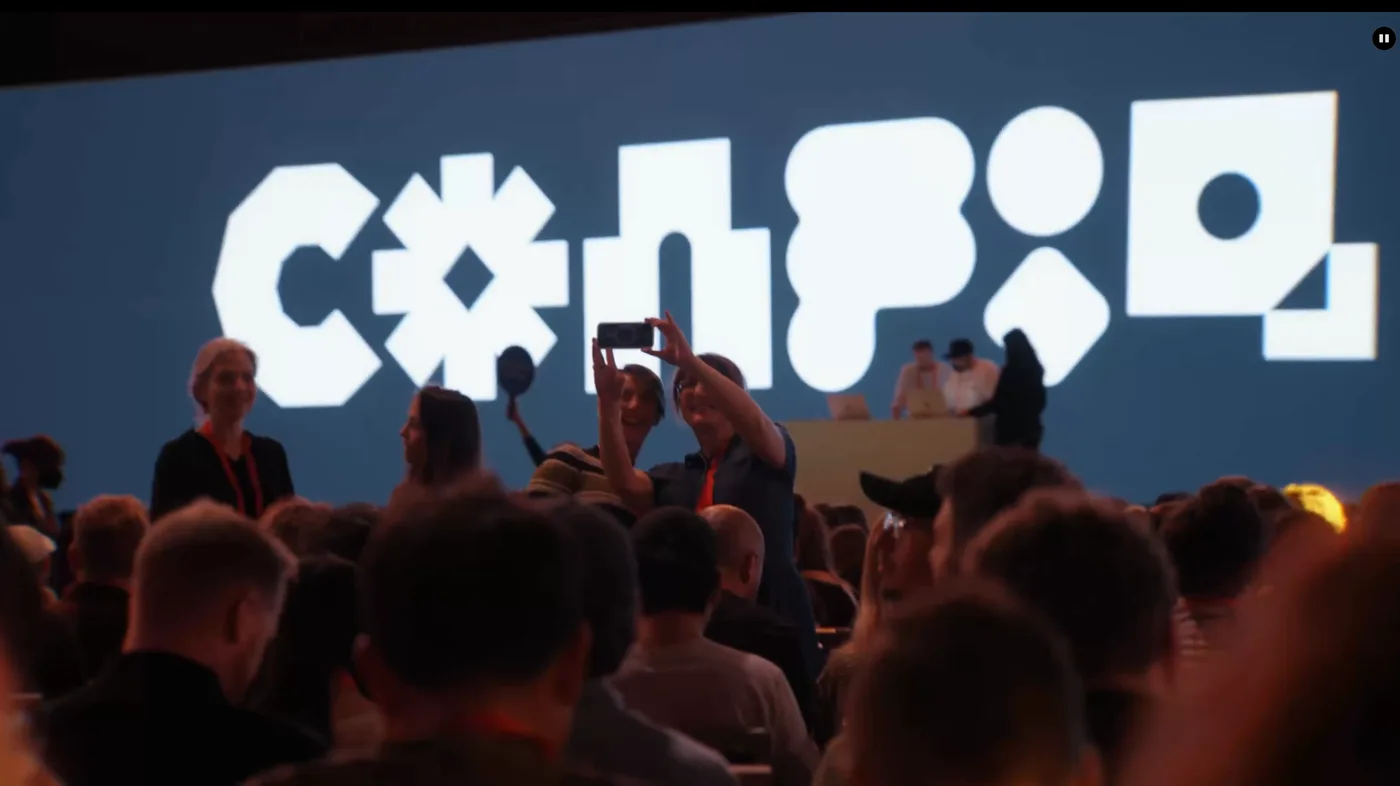
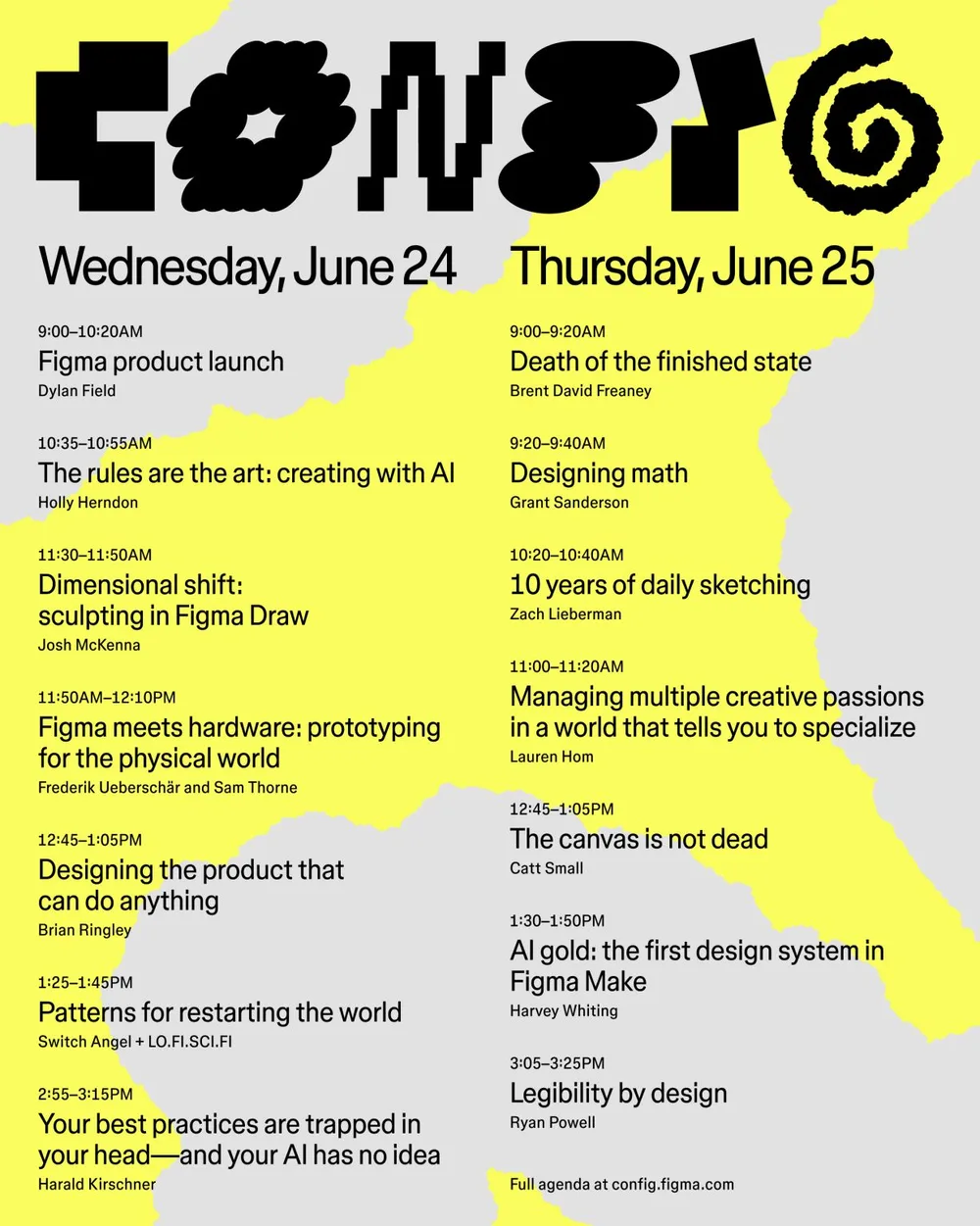
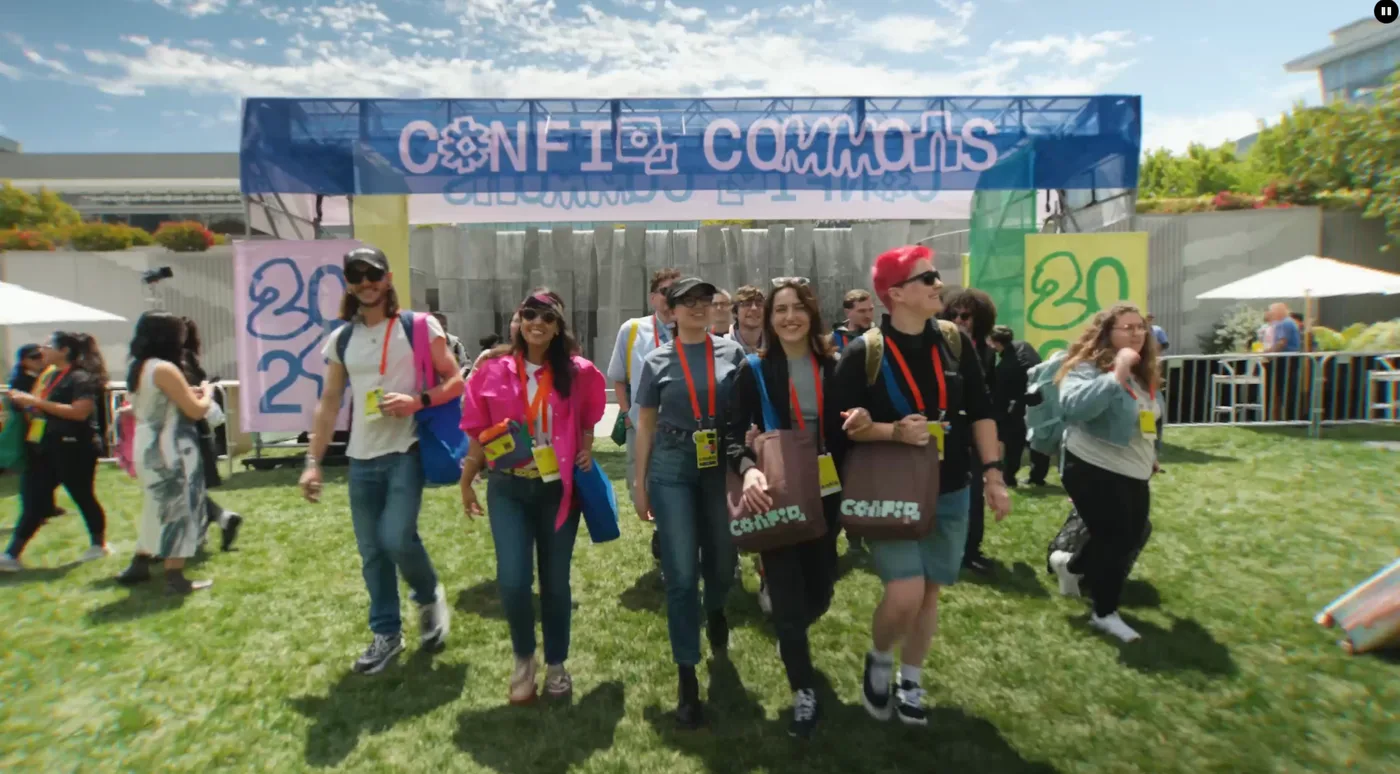
Config started as a small gathering of about 1,000 designers. This year it drew over 8,500 people in person, plus a global audience watching online. I went deep on the schedule: from Dylan Field's keynote announcements to sessions by Holly Herndon, Brent David Freaney, and Josh McKenna. What I kept hearing was the same story told from different angles. The industry is moving away from manual pixel work and rigid processes toward generation, spatial interaction, and a fierce defence of human craft.
The Evolution of the Canvas and the Toolset
To make sense of Dylan Field's announcements, you need to know where design tools have been. In the early 2000s, interface design was a mess. Designers were stuck on desktop apps built for print, passing around isolated files and hoping developers would interpret them correctly. Web 2.0 arrived and demanded reusable components, but the tooling was years behind.
Figma changed that. Dylan Field and Evan Wallace founded it in 2012 and built it on browser technology, which meant real-time collaboration was native from day one. The isolated file era ended. Today, Figma covers the full product lifecycle: brainstorm, design, and build.
This year's Config launches, including UI3 and Variables, give designers native design tokens and fluid responsive layouts across every platform. Dev Mode and Code Connect are the parts that interest me most. They turn the canvas from a drawing board into something that actively feeds implementation. Catt Small said it best in her session: the canvas isn't dying. It's getting smarter.
The Shift in Design Paradigms
- 1990s to early 2000s: Desktop-bound graphic editors built for print. Files were siloed, implementations were inconsistent.
- Mid 2000s to 2010s: Vector tools with local symbols. Web 2.0 arrives and dynamic interfaces start demanding reuse.
- 2016 to 2022: Real-time, browser-based collaboration. Design access democratised for the first time.
- 2023 to now: Variables, Dev Mode, token architecture. The canvas becomes an active implementation platform, not just a drawing tool.
The Death of the Finished State and the Rise of Living Systems
For years, visual consistency meant a style guide. Usually a PDF. Often out of date within a month and completely disconnected from the actual codebase.
As digital products got more complex through the 2010s, teams turned to component libraries for consistency. Jenifer Tidwell had conceptualised design pattern languages back in 2005, and that thinking eventually produced systems like Google's Material Design, Shopify's Polaris, and IBM's Carbon. These stopped being optional references and became critical infrastructure.
Brent David Freaney's session pushed this further. A modern product is never truly finished. Design tokens, platform-agnostic semantic variables like primary.dark.elevated, let enterprise apps shift instantly across iOS, Android, and web in response to user preferences, cultural contexts, or brand changes. Software is alive now. It mutates constantly based on real data and continuous deployment.
AI is accelerating that mutation. Harvey Whiting showed how Figma Make points toward generative UI: interfaces that adapt autonomously based on what users need in the moment. But Karri Saarinen from Linear gave what I thought was the most important counterpoint of the conference. Over-relying on rigid systems strips products of emotional resonance. Linear deliberately avoids heavy process and treats designers as product owners. When AI can generate a perfectly compliant interface in seconds, the thing that makes your product different is craft. That's your moat.
Artificial Intelligence: From Automation to Collaboration
AI didn't arrive suddenly. The groundwork goes back to Alan Turing's 1950 Turing Test and the Dartmouth project in 1956. Expert systems in the 1980s automated rule-based tasks. Machine learning in the 2010s brought predictive analytics. Then in 2014, Generative Adversarial Networks changed the game. When Large Language Models arrived, AI stopped being a calculator for analysis and started generating original, high-fidelity content.
Holly Herndon put it in a way I keep coming back to. She argues that AI shifts creativity from executing a medium to defining its rules. When a model can produce a photorealistic image or a working code block in milliseconds, the craft lives in how you train it, how you prompt it, and how you set the constraints. The designer stops being a maker and becomes a director.
Harald Kirschner added an important caveat. Current generative models have a real problem with context. An LLM can process enormous amounts of public data, but it has no institutional memory. It doesn't know your brand guidelines or the unspoken nuances your team has developed over years of working with customers. If you want AI output that actually fits your business, you have to do the work of grounding it: feeding it your proprietary data, your schemas, your rules.
The AI Evolutionary Stages
- The Foundational Era (1950s to 1980s): Symbolic AI and Expert Systems. Automation of rule-bound tasks.
- The Predictive Era (2000s to 2010s): Machine Learning and Deep Learning. Anomaly detection, behaviour prediction, data-driven testing.
- The Generative Era (2020s): LLMs, GANs, Transformer Architectures. Text-to-image, text-to-code, generative UI prototypes.
- The Agentic Era (emerging): Autonomous AI Agents. Self-executing workflows, context-aware maintenance, proactive problem solving.
Andrew Reed from Sequoia talked about what he calls vibe coding: a natural language dialogue between a human and an AI where the human steers high-level direction and the AI does the generation. You're not typing code. You're reviewing it, pushing back on it, and deciding what's worth keeping. Human judgement stays in the loop. The execution gets faster by an order of magnitude.
Dimensional Shifts and the Era of Spatial Computing
AI is changing how products get made. Spatial computing is changing where they live. Josh McKenna's session on sculpting in Figma Draw, alongside what Apple designer Linda Dong shared about visionOS, made it clear that the flat screen isn't the permanent destination people assumed it was.
Computing started as abstract machines, moved to text interfaces, and then landed in 2D graphical interfaces in the 1980s. Spatial computing, through mixed-reality hardware and operating systems like visionOS, merges the digital and physical. Your environment becomes the interface.
Linda Dong made the case that moving from a bounded 2D screen into an infinite 3D space creates serious cognitive load. The answer, she argued, is a return to skeuomorphism: designing digital elements that behave like physical ones. Dynamic lighting, real shadows, spatial audio, material translucency. These aren't just aesthetic choices. They're affordances. They tell users what things do in a world without edges.
The designers who thrive in the next decade will be the ones who can blend architectural thinking, 3D parametric modelling, and ergonomic UX. Figma Draw is already moving in that direction, giving designers tools to sculpt vectors and work with dimension. The toolset is adapting. The question is whether designers are adapting alongside it.
Prototyping the Physical and the Mathematical
Software increasingly controls physical things: smart home devices, medical equipment, autonomous vehicles. When that's true, you can't design the interface without understanding the physical object it lives on. Tony Fadell, who helped build the iPod, iPhone, and Nest thermostat, has made this case better than anyone. Prototyping is how you find the failure points before they become expensive. It's how you communicate a vision that people can actually respond to.
Fadell's point isn't just that prototyping is useful. It's that it has to be structural. Ad-hoc prototyping doesn't work. It needs executive buy-in, dedicated resources, and a formal place in the process. As design platforms extend further into hardware interactions, that barrier gets lower. Digital designers can now simulate physical constraints and test assumptions without needing a full engineering team.
Grant Sanderson's talk, 'Designing math', was one of the more surprising sessions for me. As interfaces get more dynamic, responsive, and spatial, parametric design and mathematical logic become essential skills. What I liked about Sanderson's argument is that Figma is making this accessible. Variables and expressions built natively into the tool let visual designers work with mathematical logic without needing a computer science background.
The Art of the Pivot and Business Resilience
Rapid prototyping and customer validation aren't just design practices. They're how companies survive. Stewart Butterfield's story with Slack is the clearest example I know. Slack was born from a failed video game called Glitch. Butterfield looked at the numbers honestly: customer acquisition costs were unsustainable. The financial backing was solid, the engineering team was talented, and users were growing. But the unit economics were irrefutable.
Instead of throwing more money at a broken model, Butterfield's team shut it down and turned their attention to something they'd built for themselves: the internal messaging system their engineers used while building the game. The pivot worked because they had the honesty to abandon a flawed assumption and the analytical discipline to see that an internal tool was solving a real market problem better than the thing they'd set out to build.
The 4 Stages of Customer Development for Resilience
- Customer Discovery: Talk directly to potential users and verify that the problem you think you're solving is actually a priority for them. If it isn't, pivot now.
- Customer Validation: Prove the economics work. Build a repeatable sales process. If your cost of acquisition exceeds lifetime value, pivot. This is exactly what killed Glitch.
- Customer Creation: Scale demand. Execute growth and marketing to drive adoption and establish your position in the market.
- Company Building: Formalise the structure. Move from an experimental startup model to specialised teams that can support sustained growth.
Human Craft, Passion, and Design-Led Leadership
I find the counter-movement to AI automation more interesting than the automation itself. Zach Lieberman has been making something by hand every single day for years. He talks about it in terms of intentionality and the productive struggle of creation. AI can generate infinite variations in seconds, but it can't replicate what happens when a human genuinely doesn't know what they're making yet.
Lauren Hom made a related point about specialisation. The pressure to hyper-specialise is everywhere in the industry. Her argument is that cross-disciplinary passion, connecting typography to culinary arts to illustration, produces a kind of creativity that statistical models can't touch. Ryan Powell's session on legibility reinforced this. Design is ultimately about clear human communication. You can generate a technically perfect interface. But making it communicate with empathy, cultural sensitivity, and real clarity still needs a person.
Brian Chesky made the strongest argument for design leadership I heard at the whole conference. When COVID-19 wiped out 80% of Airbnb's revenue, Chesky, who has a formal design background, did the opposite of what most CEOs would do. He tore down the organisational silos and put designers in co-equal roles with engineers and product managers as the architects of the full user experience.
He then built a systematic process for understanding customers: user interviews, rigorous data analysis, and executives using the product directly. Airbnb stopped chasing short-term monetisation and focused entirely on perfecting the core product through a design lens. The result was nearly $4 billion in free cash flow the following year. That's not just a design case study. That's a business case study.
Conclusion: Synthesising the Future of Product Building
Looking back at everything Config surfaced, the direction is clear. The boundaries between design, engineering, and product management are dissolving. AI and collaborative platforms are accelerating that. But what I keep coming back to is the part of Config that wasn't about AI at all: Lieberman making something every day, Hom defending cross-disciplinary passion, Chesky rebuilding a company around empathy. As execution gets cheaper, the things that are genuinely hard to automate get more valuable. That's the thread running through everything.
Key Takeaways for 2026 and Beyond
- Shift from maker to orchestrator. Learn to manage autonomous AI agents and complex systems. The friction of execution is approaching zero. Your value will increasingly come from your ability to direct agents, set precise parameters, and hold a coherent mental model of the whole system.
- Invest in taste. When AI commoditises standard UI and design systems enforce structural consistency, your brand identity and empathy are the moats that matter. Craft stops being an aesthetic preference and becomes a measurable competitive advantage.
- Prepare for spatial design. 3D is coming. Learn architectural principles and spatial psychology. The 2D screen was never the endpoint, just where we started.
- Build for resilience. Rapid prototyping and honest customer validation aren't optional. The teams that win will be lean, cross-disciplinary, and focused on the things algorithms genuinely can't do: strategy, craftsmanship, and solving real human problems.
Frequently Asked Questions
What was the main theme of the recent Figma Config conference?
From where I sat, Config 2026 was really about one question: what do humans do when AI handles the mechanical work? The answer the conference kept landing on was design thinking, strategic empathy, and craft. The specific tools, Dev Mode, Code Connect, Figma Make, and Figma Draw, all pointed toward a world where the canvas is less about drawing and more about orchestrating.
Will AI replace UI/UX designers?
No, but it will change what the job looks like. The designers I saw thriving at Config weren't fighting AI; they were directing it. The role is shifting from manual maker to creative orchestrator: someone who sets the parameters, curates the output, and brings the human empathy that a model can't replicate.
What is a token-driven design architecture?
Instead of hardcoding colours or sizes, you use semantic variables like primary.dark.elevated. This means your software can adapt instantly across devices, platforms, and user preferences without someone manually redesigning everything. It's the difference between a static stylesheet and a living system.
How did design save Airbnb during the pandemic?
Chesky restructured the company around design thinking: eliminated silos, put designers at the centre of the product process, and built a systematic method for understanding customers. Instead of optimising for short-term revenue, he focused entirely on the quality of the user experience. The company went from losing 80% of its revenue to generating nearly $4 billion in free cash flow the following year. That's what design-led leadership actually looks like.
In short
Practical checklist
- Translate conference insight into one decision your team must make this quarter.
- Separate trend signal from hype by asking what changes behaviour now.
- Map which capabilities are now commodity and where your craft edge remains.
- Set one experiment that combines AI speed with human review standards.
- Review results after two weeks and decide what to scale or stop.
When to use this approach (and when not to)
- Use this approach when decisions carry customer, revenue, or delivery risk.
- Use it when multiple teams need consistent quality standards.
- Use it when you need repeatable outcomes, not one-off output.
- Do not treat conference headlines as a mandate to rebuild your toolchain overnight.
- Do not chase every demo feature without naming one decision your team must make this quarter.
- Do not repeat sharp claims about tools, timelines, or history without sources you can stand behind.
Frequently asked questions
What was the biggest signal from Config 2026?
That AI is rapidly reducing mechanical production work. The highest-value work is shifting to product judgement, systems thinking, and craft decisions that require human context.
Does AI make design craft less important?
No. It makes craft more important. As generation gets easier, teams are judged more on clarity of thinking, quality of decisions, and how well products fit real user and business constraints.
How should product teams act on Config signals right now?
Pick one workflow where AI reduces mechanical effort, define quality checks, and run a short experiment. The goal is decision quality plus delivery speed, not tool excitement.
What capability matters most as generation gets easier?
Judgement. Teams need stronger framing, prioritisation, and taste so generated output serves real product goals.
How do we avoid trend-chasing after conferences?
Translate each trend into one concrete hypothesis, one measurable outcome, and one stop condition before investing further.